Longtime internet blogger, sci-fi writer and generally cool dude Cory Doctorow has been in the UK promoting his new book. In between speaking gigs at Oxford University and the Frontline Club, the tour stop that caught my attention was Doctorow’s appearance at the headquarters of the Trades Union Congress (TUC), chatting to members of the UK’s tech unions. Until recently, unionisation has not really been a thing for tech workers. It is now.
Enshittification, a word coined by Doctorow in blog post from November 2022, is a broad term to describe exactly what’s happening to our tech platforms. It’s the process where something starts out fun and appealing to end users, finds ways of locking them in, then ultimately ends up being extractive, unpleasant and – at times – downright dangerous. In his book, Doctorow tracks and details this process across sites like Amazon, Facebook and X (Twitter). During this talk at the TUC (which you can watch in full on Youtube), he called on tech workers to do their bit to help build the “digital nervous system” we need.
Here are five things Doctorow said that resonated:
1. Market concentration
Our current iteration of the web is dominated by “five giant websites [each] filled with screenshots of the other four”. These new intermediaries have gone “from being helpers to being gatekeepers…they start extracting data, money, bargaining power from workers and from the communities we serve”. We didn’t get here suddenly. It’s taken the 45 years or so, since the early 1980s and the economic policies of Thatcher, Reagan and others which led to a complete lack of interest in enforcing any kind of competition law, thus allowing monopolies to thrive.
2. We’re still the product
We all thought we were enlightened when we realised that if we weren’t paying for something, then we must be the product, but things don’t actually change when we start paying: “the platform will take everything it can get.” For example, I might pay good money for my iPhone, but Apple still uses it to spy on me and serve up targeted ads (despite the cute feature allowing me to check a box forbidding any app I’ve downloaded to track my data).
3. Regulatory capture
Now that the tech sector is dominated by a handful of companies, it becomes much harder for regulators to do their job. In January Kier Starmer fired Marcus Bokkerink, head of the UK’s Competition and Markets Authority, and replaced him with Doug Gurr, who used to be head of Amazon UK. He is now responsible for regulating his old company (we can imagine how that’s going to work). Meanwhile in Ireland, an ex-Meta lobbyist, Niamh Sweeney, has just been appointed to the Data Protection Commission. Chances are they’ve already had to sign a non-disparagement clause. So – the politicians have no will and the regulators have no teeth.
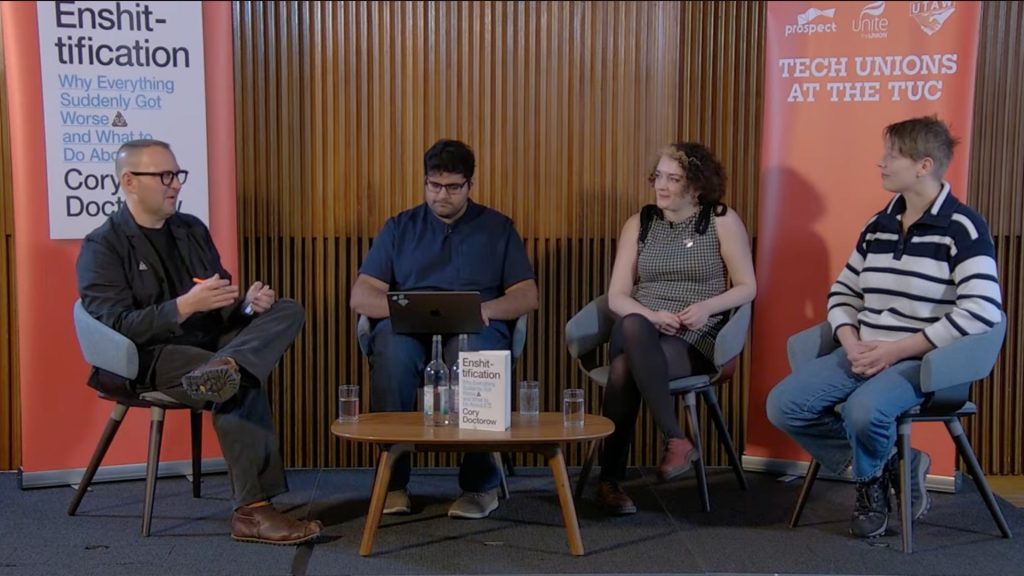
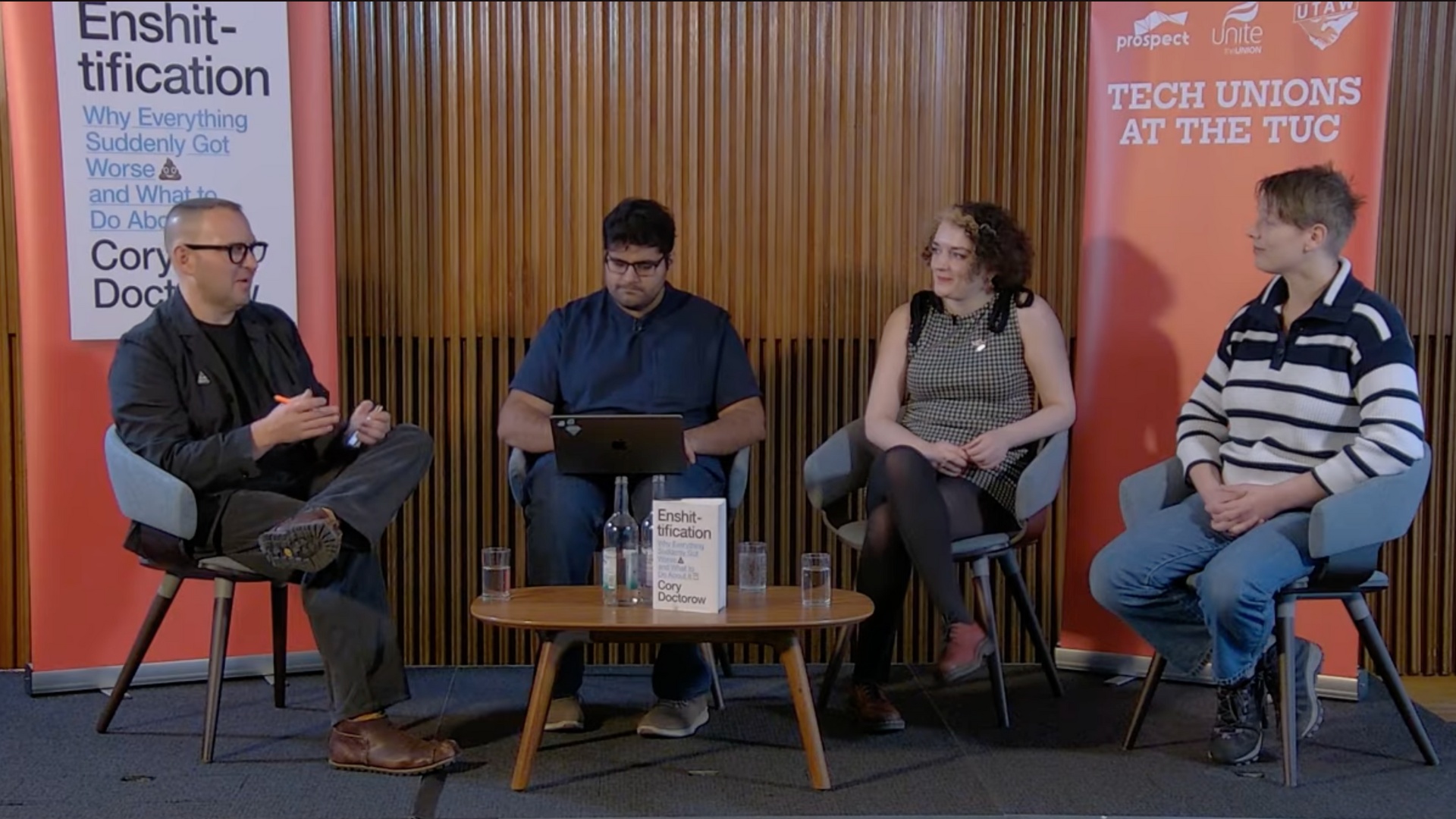
The Tech unions against enshittification panel with (left to right) Cory Doctorow, Sarthak (Deliveroo/ Prospect), Eleanor (TikTok/ UTAW) and Gabrielle (Google/ Unite)
4. Tech workers are waking up
Until recently, tech workers haven’t needed unions because they were powerful – because their skills were in demand and talent was hard to come by. “This is why you got the gourmet cafeteria and the free kombucha and the massages and a surgeon who will freeze your eggs so you can work through your fertile years. Not because they like you. It’s because they’re worried that if you quit, a million dollars will walk out the door.” This has always been the case for developers and engineers, but not for the majority of tech employees – the factory assembly-line workers or Amazon drivers. But now supply is catching up with demand even for coders: “Automation tools are an extremely powerful form of digital whip that can set quotas and enforce working conditions to a fine degree in a way that even the most intrusive control freak boss never dreamed of.”
5. A tailwind is blowing
Although it feels like it’s happening slowly, there is a global trend towards increased tech regulation. It started with the Digital Markets Act and Digital Services Act (both 2022) in Europe. And the antitrust cases against Meta and Google in the US which kicked off during the first Trump administration. China is also keen to regulate technology – especially when it comes from the US. And Trump’s introduction of trade tariffs has angered other countries who thought they had a deal. “Weirdly Donald Trump seems to be quite good for this because all the countries that signed up to protect America’s tech companies with the quid pro quo that they wouldn’t have to pay tariffs are now finding that they’re paying tariffs anyways!”
What can tech workers do?
Doctorow concludes that there is always hope, but these things take time. He talks about how, 150 years ago, Standard Oil had a monopoly in the US, causing the Sherman Act, America’s first antitrust law, to be passed in 1890. Standard Oil was broken up in 1912: “it’s a long journey. It just it didn’t happen overnight and it happened because of all kinds of action. It happened co-terminally with the rise of labour power because one of the things that monopolies do is abuse their workers and so workers have a common enemy with trustbusters when it comes to monopolies [and] it happened thanks to muckrakers.”
He mentions Ida Tarbell who was a progressive writer and investigative journalist. She hated John D Rockerfeller because her father’s oil business had been destroyed by his empire. She wrote two books on the history of the Standard Oil Company which were serialised in a magazine and explained to ordinary people how John D. Rockefeller had got his power – this changed popular opinion and created the political will for antitrust regulation.
Time to organise
As Doctorow says, we’re going to have to build a movement. This is about grassroots organising and building power electorally and through tech unions (and the tech branches of larger unions), and holding politicians to account.
“We have an enshitto-genic policy environment. Policy makers in living memory took specific policy decisions that they were warned of at the time would have this outcome and it has come to pass. And if we can get people to realise that it’s not about like finding the moral perfection of Mark Zuckerberg (which I think is going to elude us), but instead…recovering a policy environment where people like Mark Zuckerberg fail instead of thriving. That is how we build a better internet.”