I went to the Labour Party Conference to find out what the UK’s new prime minister and his government really think about AI. Specifically, I hoped to speak to Labour MPs, advisors and policymakers about Palantir, because I wanted to understand why more of them aren’t backing the use of the break clause to end Palantir’s contract with NHS England. More broadly, I wanted to experience the general vibe and emotional response to AI at grassroots level across the Labour Party.
In the months leading up to Sir Keir Starmer’s resignation in June, Carole Cadwalladr, Beeban Kidron, Byline Times and others were openly critical of his apparently unquestioning love of Big Tech. (For a flavour of this legacy, see, for Starmer’s race to AI-ify public services and Do you want human civil servants or AI bots? In private chats, people talked about a distorting but impenetrable “tech bro” culture around the (then) prime minister. I wondered if that culture is still dominant, or if it was slowly morphing into something else.
Even before he took office, prime minister Andy Burnham signalled a different direction, saying he wanted to increase regulation on big tech and see more government intervention. In last week’s speech to the United Nations, Burnham reiterated concerns about surveillance, disinformation, and the need for the UK to build its own sovereign technologies. But will things really be different this time?
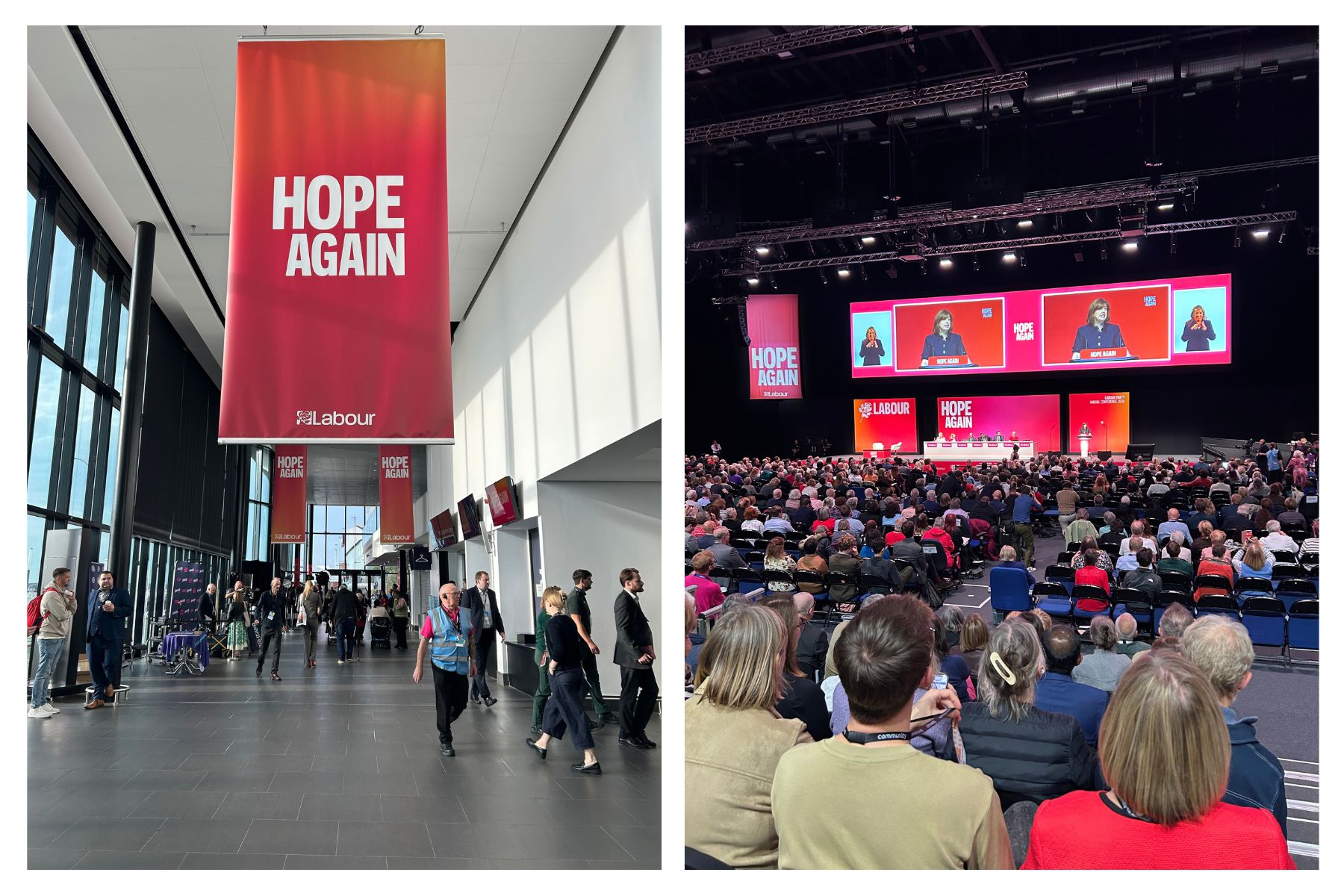
Hope Again banners at the Labour Party Conference
Hope again
The slogan for the conference was “Hope Again” and every available wall was draped in bright pink and orange ombre banners. Were people hopeful? They were definitely upbeat. I’ve not been to a Labour Party Conference before so I’ve no idea what they’re normally like. One party activist told me things have come on leaps and bounds since the 1980s when delegates would get into fist fights. “It’s so corporate now” she added, with regret. Certainly there were a lot of men in smart suits and tight shoes, and plenty of women rocking a bright pantsuit, Hillary Clinton style.
A friend told me the Labour Party conference is a bit like Glastonbury – you make plans but you never stick to them. The full programme (the main hall sessions plus fringe events – of which there are literally hundreds) didn’t come out until a couple of days before the conference started, so I’d no time to properly go through it. In addition to open events, there were private round tables and invite-only drinks receptions. I spent a lot of time feeling like a gatecrasher at someone else’s party. I didn’t how to use the conference app or save talks I wanted to go to. Let alone where to get a decent wifi signal.
I came close to power – but not that close. I saw David Lammy stop for a selfie with someone, Lucy Powell chatting to her young advisors and Louise Haigh being interviewed on LBC. Before the conference, I hoped I might at least be able to talk to my own MP (who’s been sending pretty standard responses to my Palantir letters), but apparently he prefers dog shows and local fetes to party conferences.
Conference highlights
In the end, the highlights for me were the spaces where I was made to feel welcome and where people either knew me or had the same cause in common: the Campaign Fringe, the Pink Hair Data Whistleblower film screening and the Back The Break Clause demo.
1. The Campaign Fringe
I arrived at Camp and Furnace late morning on Monday for Campaign Lab’s Campaign Fringe event, the bouncers were bleary-eyed after Dawn Butler’s Jamaica Party on Sunday night. Apparently the Brent East MP was DJing and dancing til 3am. She’s got more stamina than me. Anyway, Camp and Furnace is a music venue and feels very much like a nightclub, even at midday. But the vibe was great, and very…fringe.
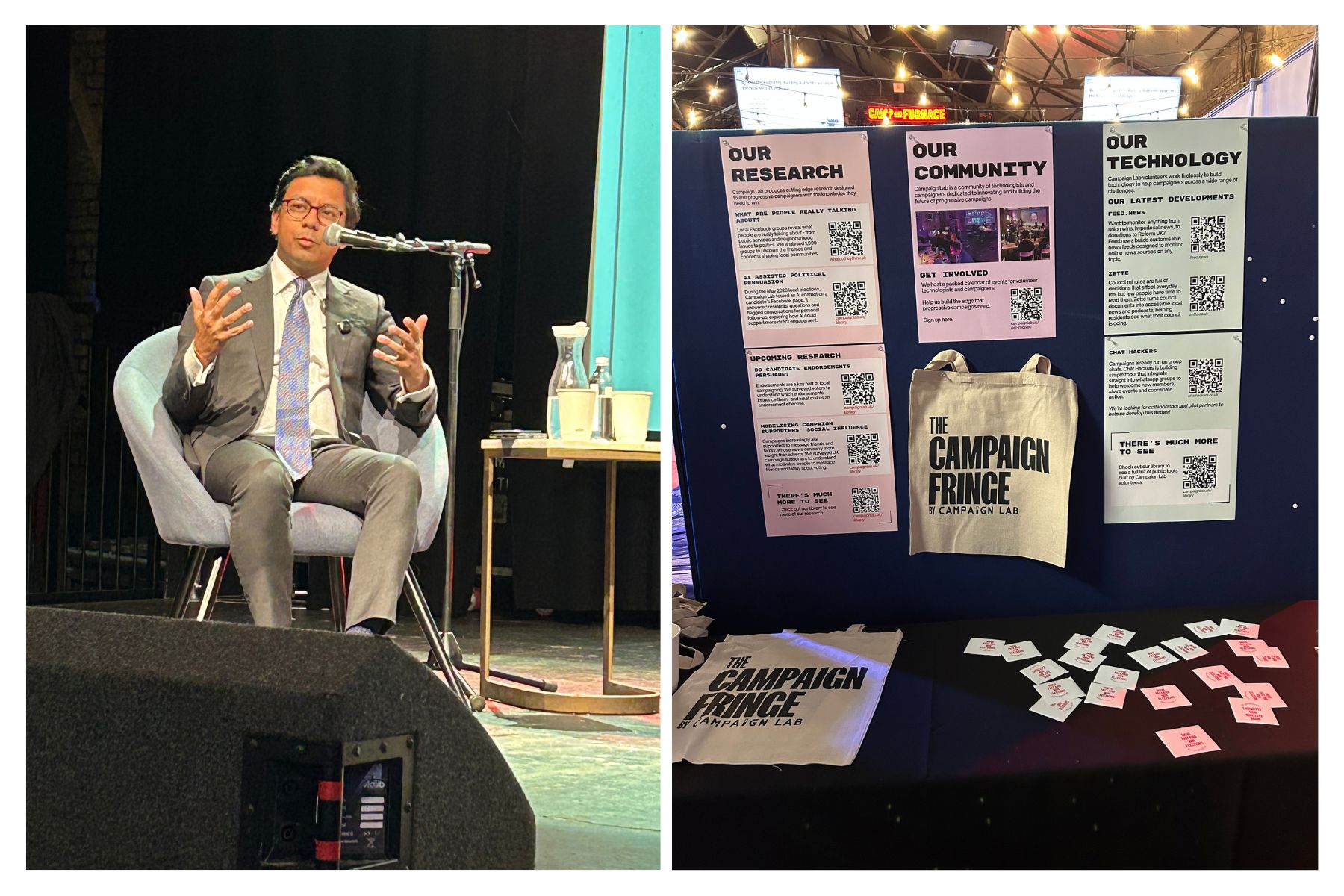
There were trays of lollies and stickers everywhere, and tote bags galore. The back room was filled with stalls set out by different organisations promoting their progressive campaigns. Exhibitors ranged from 38Degrees, who are hosting a number of petitions against Palantir (Zack Polanski’s Stop Palantir in Public Services has more than 178,000 signatures) to the AdFree Cities network: their art installation, Billboard Dystopia, is a hoarding made from e-waste showing how big polluters use advertising to greenwash their brands.
The panels I saw were great. My favourite was the after-lunch session on AI in campaigning with Kanishka Narayan MP, the new Minister for AI; Josh Carrington, Chief Technology Officer of The Labour Party; James Rees, Co-Founder, Movement and Laura Williams, Scientists for Labour and a Labour councillor in North Herts. Hannah O’Rourke, Campaign Lab’s co-founder and director, chaired the session really well. I learned what an MCP is (a Model Context Protocol Server – like an API but built for AI agents not humans) and that Kanishka Narayan has been using AI to run “synthetic focus groups” in his Vale of Glamorgan constituency.
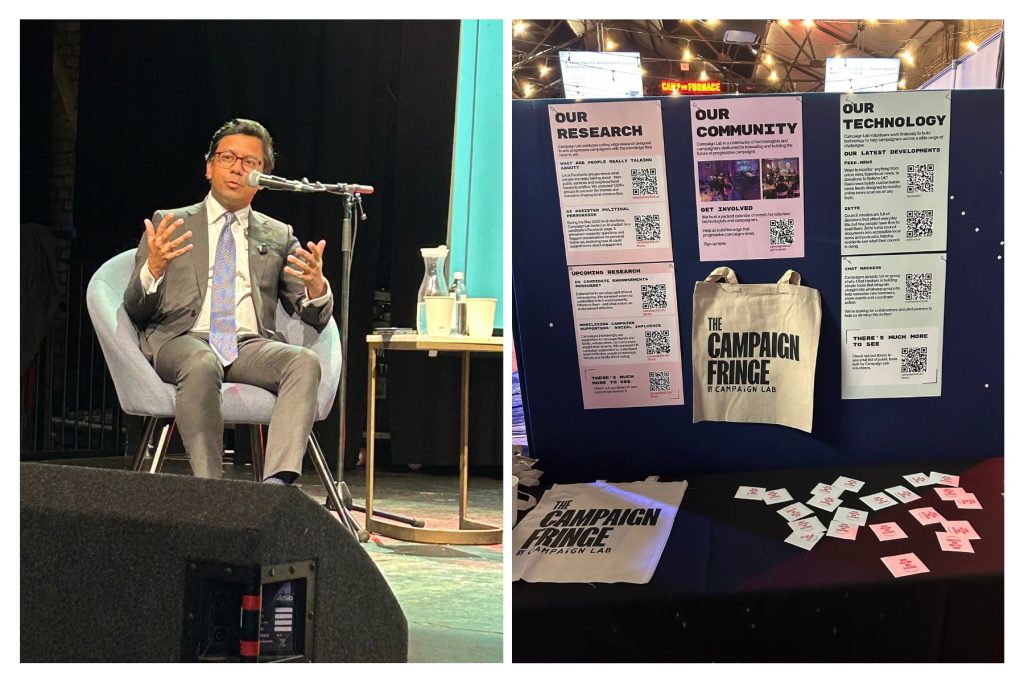 Kanishka Narayan, Minister for AI (left); Some Campaign Lab merchandise (right)
The right language
There was a lot of talk about how we need to make campaigns more scalable and efficient, but also how “we have to do best job in shaping technology in light of our values. We need bottom-up not top-down” (Narayan). Josh Carrington said a lot of members of the parliamentary Labour Party were coming to him with small language models they were building to hope solve local issues. James Rees also said he was “a big fan of small language models at a community level”.
After the panel I followed Kanishka Narayan back to the main conference venue and a more bullish discussion on AI in business. This time he was being interviewed alongside Accenture’s UK CEO, Matt Prebble. “What role can the government play in accelerating AI adoption?” asked the session chair (Carolyn Dawson, CEO, Founders Forum). “We have to ask, what can AI do to enable dignity and opportunity in public services?” responded Narayan. “We don’t want to make mistake of specifying the kit. Government have made those kinds of mistakes in past….we need to think deeply about open source, for example.” Later on, in response to another question about AI, he said, “it’s not inevitable. Each one of us has a degree of agency.”
Open source, values, dignity, bottom-up, not inevitable, agency…they may be buzzwords and phrases, but I’m happy to hear the minister for AI using this type of language. It implies he is at least aware of public concerns about AI, and signals a change in direction from Starmer’s full throttle approach.
2. Pink Hair Data Whisleblower
On Monday night, I went to a screening hosted by The Citizens and Doc Society at FACT Liverpool. The short film, Pink Hair Data Whistleblower (or #pinkhairdatawhistleblower to give its correct, 2018-style hashtags-with-everything title) is a 26 minute documentary by Marc Silver about Chris Wylie, the Cambridge Analytica whistleblower. The aim of the screening was to show how we totally failed to heed the warnings of the Cambrige Analytica scandal, primarily in the weaponsation of our personal data. As Carole Cadwalladr wrote (on her Substack): “There’s a particular reason for showing it now and doing so at the Labour party conference: everyone’s favourite spytech firm, Palantir.“
In the film, Wylie explains how Cambrige Analytica helped turn Facebook into “a full service propaganda machine [which] knows so much about a person that it can feed them more and more of the content they want. Soon they go down the rabbit hole. And then you’ve changed their minds politically.” He notes how Facebook has become “a battlefield”, and “elections are no longer a domestic event. There’ll always be an international dimension to elections from now on”.
At the end of the film, Wylie leaves us with a still unanswered question: “If we overly segment, if we overly target, we risk fragmenting society in a way where we don’t have any more shared experiences, and we don’t have any more shared understanding. If we don’t have any more shared understanding, how can we be a functioning society?”
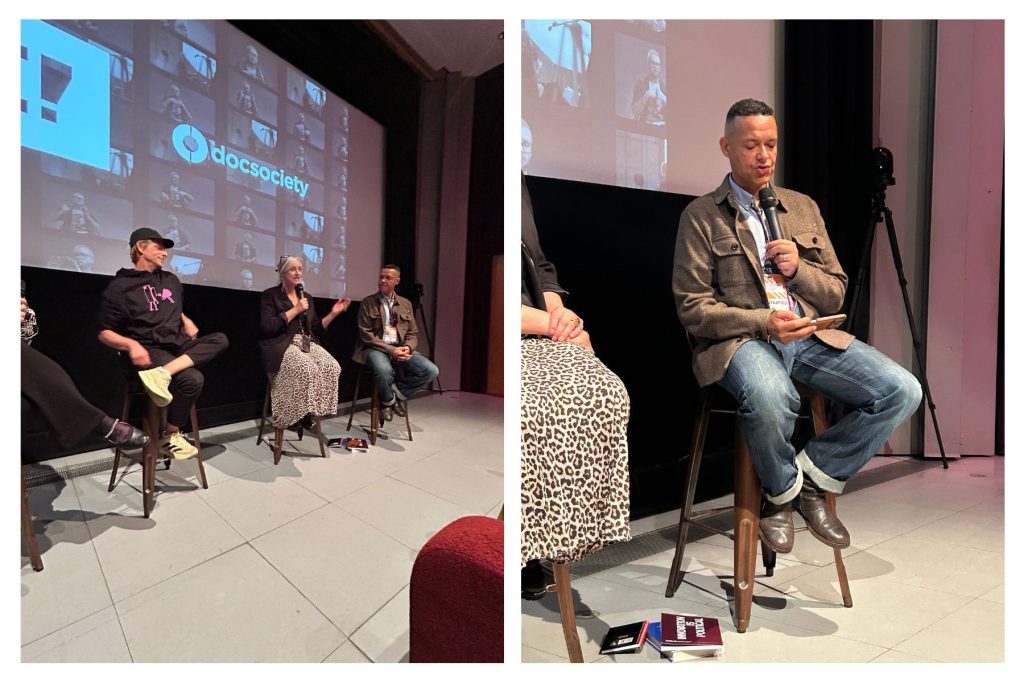
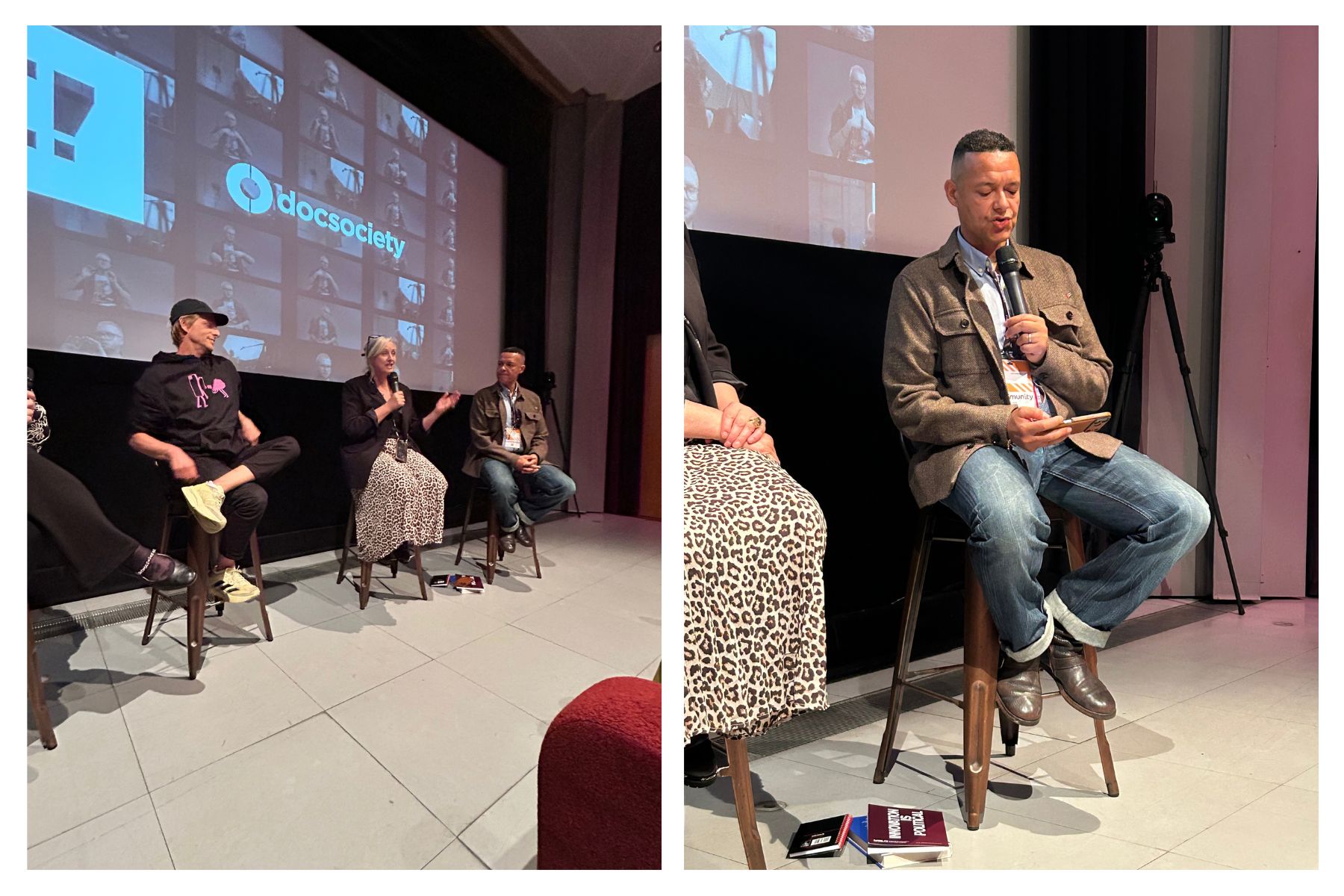
The panel at FACT Liverpool (left): Marc Silver, Director, #PinkHairDataWhistleblower; Carole Cadwalladr, journalist and co-founder, The Citizens; Clive Lewis MP; (right) Clive Lewis reading Tom Watson’s response to his article
Time to pick a side
In the panel discussion that followed the screening, Carole Cadwalladr said: “The scandal of what happened then is that it’s so much a microcosm of what’s happening now…the collection of all our data…that’s Palantir. Everything that we’re seeing in this moment with AI, with data, with the big tech ceos, it’s all happening.”
She added that Damien Collins, the Conservative MP who chaired the DCMS committee inquiry into Cambridge Analytica, published an excellent report nearly ten years ago, but nothing has been done since. “People in the political class need to pick a side” she said, referring specifically to Lord Tom Watson‘s recent acceptance of a leadership role at Palantir.
Clive Lewis is one of a handful of Labour MPs to have publicly backed the break clause in Palantir’s contract with NHS England. He started his contribution to the panel by reading out Tom Watson’s (private) letter to him regarding his recent column in The Guardian. Unsurprisingly, Tom Watson was highly defensive of his move to Palantir, citing it as a way of protecting British jobs (read more about his letter to Lewis in The Nerve). Lewis says Labour politicians need to take a much firmer stand against big corporate lobbyists: “If Labour doesn’t pick a side, they’ll loose voters to the populists. They already are.”
3. Back The Break Clause demo
On Tuesday, I missed Andy Burnham’s big speech because I was making one of my own. To a small audience made up mostly of a few policemen and a dancing frog. Just outside the conference perimeter fence, on the Royal Albert Dock, in front of the Liverpool Wheel.
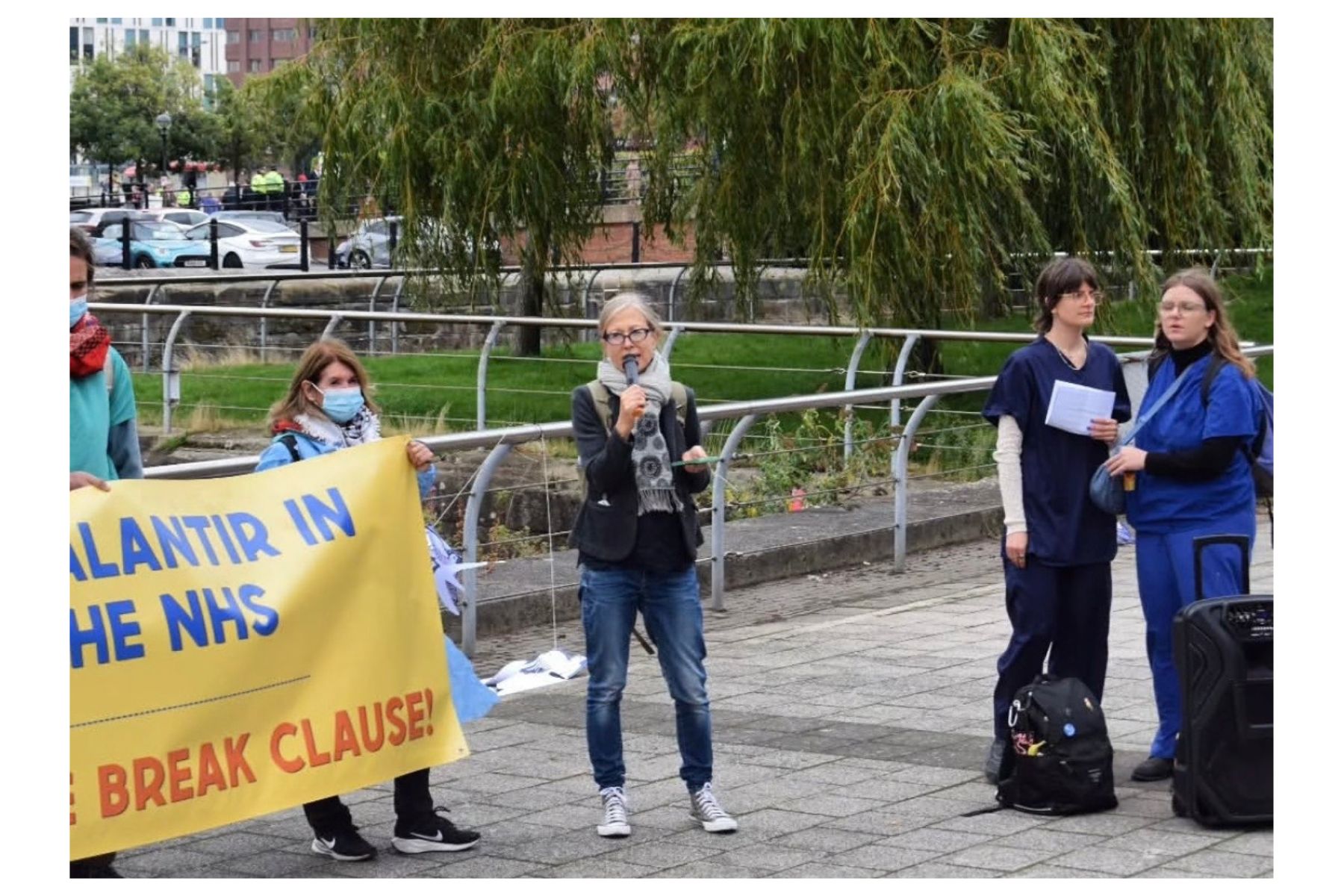
We were protesting against Palantir in the NHS and calling on MPs to back the break clause. I talked about my experience as a patient, and why I believe Palantir’s values are incompatible with healthcare. As an anthropologist, I’ve been thinking a lot about the impact on NHS workplace culture, and the affect of an organisation like Palantir on all of us who use the NHS. “Surveillance and warfare should be not be near healthcare”, was one of the chants we sang.
There were about 25 of us: a mix of GPs, hospital consultants and health workers. Most people were wearing scrubs, some came from civil society groups, like me. A doctor led the chants: “We are health workers. We won’t be silenced” and “Say no to surveillance tech”, and, finally, “Back the break clause now”! Some passersby took leaflets. A handful of people filmed us on their phone cameras. The frog danced and waved a coloured flag. A handful of delegates walked past. It was windy and our long banner kept flapping up and down. Meanwhile, a few yards away at the main entrance to the conference, Steve Bray, still protesting Brexit, played You’ll Never Walk Alone over his sound system. I like to think he did it for moral support.
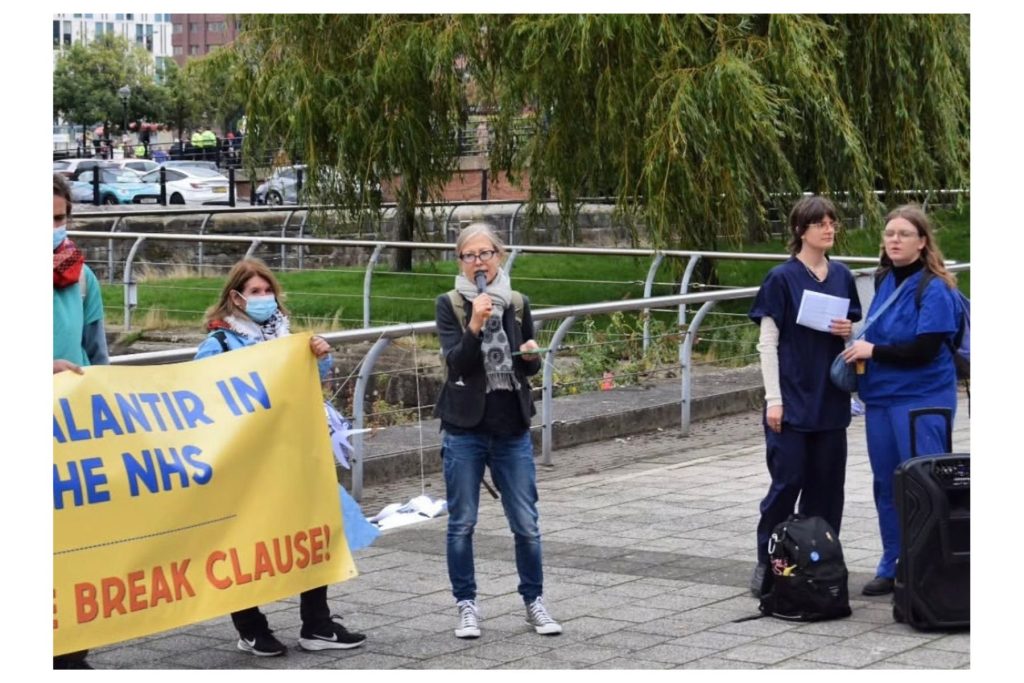
Giving my speech outside conference, as part of the Back The Break Clause demo
Too contentious
It’s hard to tell what impact a small demo like this will make. We got some coverage in Novara Media and The Citizens. But Palantir is a contentious issue – and definitely something the Labour party leadership did not want to be discussed at this conference. At the end of last week, there was a call for an emergency motion on Palantir, but that was subsequently blocked. After speaking to other delegates at the conference I came to the conclusion that it was all about managing the news cycle. The government wants some control over media headlines, and it certainly wanted maximum coverage of Andy Burnham’s first conference speech as prime minister. A vote to back the break clause in Palantir’s NHS contract, and to cut Palantir’s ties across all our public services, would have take up a lot of oxygen.
Meanwhile, local councils up and down the country are actively debating Palantir. Last week, Manchester voted to remove Palantir from all its services and two days ago, Liverpool Council voted unanimously to raise concerns about Palantir’s access to patient data. In her conference speech on Sunday, Louise Haigh hinted that the government may well heed public opinion and ban Palantir from the NHS.
Lessons for next time
Was it attending the Labour Party Conference worth it? I guess so. I met some great people. In the end, I left feeling that Andy Burnham’s government is at least trying to do things differently when it comes to big tech and AI. Even among my fellow demonstrators there was some confidence that Burnham will agree to back the break clause in NHS England’s contract with Palantir, that he’s just waiting for the right moment. I feel there is a new wariness around, and a new – more cautious – gap just beginning to open up between the UK and US tech.
Certainly there was a a lot of focus at the conference on the importance of sovereign technology, alongside with the strong message of re-industrialisation. Britain takes the G20 presidency next year and, in his speech, Burnham said he will use that role to put AI (and AI safety) centre stage. The aim is to develop a new global code that captures AI’s benefits while being honest and realistic about its risks. This all sounds great. But it will be a tough call. I just hope Burnham has the right advisors around him to help make that happen.
Main photo: The Campaign Fringe’s panel on AI with (left to right): Kanishka Narayan MP, Minister for AI; Josh Carrington, CTO, The Labour Party; Hannah O’Rourke, Co-Founder & Director, Campaign Lab; James Rees, Co-Founder, Movement; Laura Williams, Scientists for Labour & Councillor, North Herts